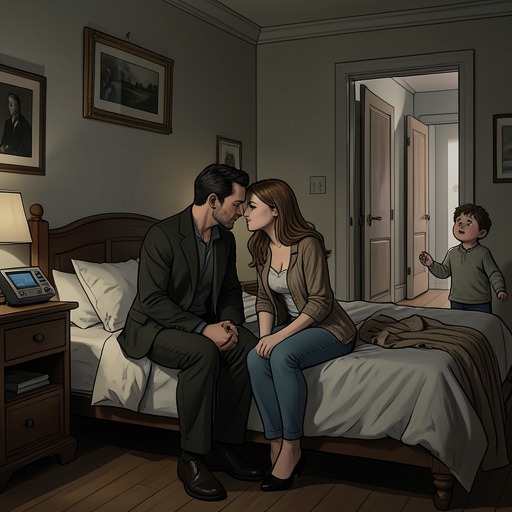
“War” as a motif for inner conflict
La uruguayaThe word war functions as a recurring motif for conflict that Lucas Pereyra cannot, or does not, state directly. First heard by Catalina while he is asleep, it returns in a later dream and acquires a second meaning when a message from Magalí Guerra appears on his phone. By the time Lucas imagines wanting war against Catalina, the word has gathered together his private desire, his fear of exposure, and the resentment accumulating inside their domestic routine. Its force lies in the contrast between what he says aloud and what he keeps to himself.
A Word Heard in Sleep
Catalina tells Lucas that he has spoken in his sleep and frightened her. When he asks what he said, she explains that he repeated the same word as on an earlier occasion: war. The repetition makes the word more than an isolated fragment of a dream. It is already familiar to Catalina, but Lucas does not recognize its significance and responds with uncertainty. The difference between her alarm and his apparent lack of understanding establishes an early divide: the word is present in their shared life, yet its meaning remains inaccessible even to the person who speaks it.
The dream does not supply an explanation. Instead, it leaves the word suspended between involuntary expression and conscious interpretation. Lucas cannot account for why it recurs, and the narration does not confirm that the dreams carry a single, stable message. That uncertainty matters. War names a conflict before Lucas has openly identified its objects or admitted its direction; the motif registers pressure without converting it into a clear declaration.
Privacy, Secrecy, and Discovery
The word becomes newly charged when Lucas writes to Magalí Guerra to arrange a meeting. He says that he never leaves his email open and that the closed account had given him a private space within his relationship with Catalina. He describes this protected mental territory as necessary even when all he wants is silence. His concern is not only that a message might disclose an attachment, but that a part of his mind might cease to belong to him alone.
Against that desired separation, Lucas imagines couples gradually becoming a single, synchronized body. He describes shared routines and habits as a process of erasing the boundary between two people, with a child seeming to seal the union. The image of a two-headed monster gives the fear an extreme form: the partners become symmetrical, reflect one another, and act as if they had only one desire. Lucas recognizes that he and Catalina have been drawn into this closeness despite resisting it. He presents their former distinction as weakened, with his body seeming to continue into hers, while the discovery of his sleeping speech and her reading his email exposes the breach in their supposed privacy from opposite directions.
This imagery makes war an inverse of fusion. Lucas fears a relationship in which the self has been absorbed, yet the privacy he tries to preserve is compromised by the evidence of his own words and correspondence. His anger at Catalina for reading his messages coexists with the anxiety that the messages make his secrecy visible. The conflict is therefore not simply between partners; it also concerns the boundary between a shared life and an individual interior that Lucas insists on keeping apart.
The Message and the Suspicion
During the meeting with Magalí Guerra, Catalina sends Lucas a message asking who Guerra is. The timing catches him by surprise. He briefly imagines an impossible connection between their bodies, as if Catalina could have sensed that something had happened, but recognizes this as an irrational thought. The episode binds the motif to an ordinary act of communication: a phone notification turns a hidden correspondence into an immediate domestic crisis, even before Lucas knows exactly what Catalina has discovered.
Lucas considers how she could have seen the email. He thinks she may have encountered his account on a tablet after he used it to show Maiko videos, perhaps because he failed to close the message. He also understands why the circumstances would arouse suspicion. Catalina had heard him say war in his sleep more than once; now she has found a message addressed to someone named Guerra, arranging to meet at the same place as before. Lucas cannot comfortably explain the overlap. He considers inventing an account of an unrelated person with the same surname, but recognizes how implausible it would sound.
The connection between the sleeping word and Magalí Guerra’s name does not prove that the dream foretold the meeting or deliberately concealed a confession. Rather, the coincidence makes an existing private conflict legible to Catalina as a pattern. Lucas’s uncertainty about what she knows intensifies the motif: war has moved from an obscure word in sleep into the charged space between suspicion and explanation. His attempt to answer neutrally, identifying Guerra only with a group that had invited him to Valizas, buys little certainty; his phone then runs out of battery, leaving the exchange unresolved.
Domestic Anger Without Declaration
The motif reaches its clearest conscious expression in Lucas’s recollection of mornings with Maiko. When the child wakes early and asks for Nesquik, Lucas and Catalina compete to appear asleep. One eventually gets up, prepares the drink and coffee, and may wash the previous night’s dishes loudly enough to punish the other for staying in bed. Lucas recognizes that both have used the noise deliberately. The conflict emerges through small retaliations embedded in care work, rather than through a direct argument.
From those domestic gestures, his imagination leaps to the destruction of household and wedding symbols. He pictures smashing furniture and gifts and destroying the family arrangement they represent. These fantasies escalate into extravagant scenes of violence, but remain thoughts: when the other person asks whether everything is all right, Lucas answers that it is, while inwardly wanting war against Catalina. The contrast is decisive. Outwardly, the household continues through coffee, dishes, and attention to Maiko; inwardly, frustration has become a wish for open conflict that Lucas still does not voice.
War thus gathers meaning through recurrence and contrast rather than through a single decisive confrontation. It begins as a word Lucas repeats without remembering, becomes entangled with the secret correspondence that threatens his privacy, and finally gives a name to resentment produced by the ordinary demands of shared family life. The motif does not resolve the couple’s conflict or disclose a complete explanation for the dream. It shows instead how an unspoken division can persist beneath routine, becoming harder to ignore when separate fragments—the repeated word, the email, the message, and the morning contest over who will rise—begin to converge.